

As of early February 2026, tokenized real estate on public blockchains has surged to a total value of $392.5 million across 58 assets in 10 countries, with the United States and United Arab Emirates commanding nearly 80% of this on-chain market. This dominance underscores a pivotal shift in tokenized real estate USA UAE dynamics, where innovative platforms like RealT, Lofty, and Prypco are fractionalizing high-value properties into accessible digital tokens. Investors now hold shares in everything from New York skyscrapers to Dubai marinas, attracting 10,440 token holders amid growing regulatory support.
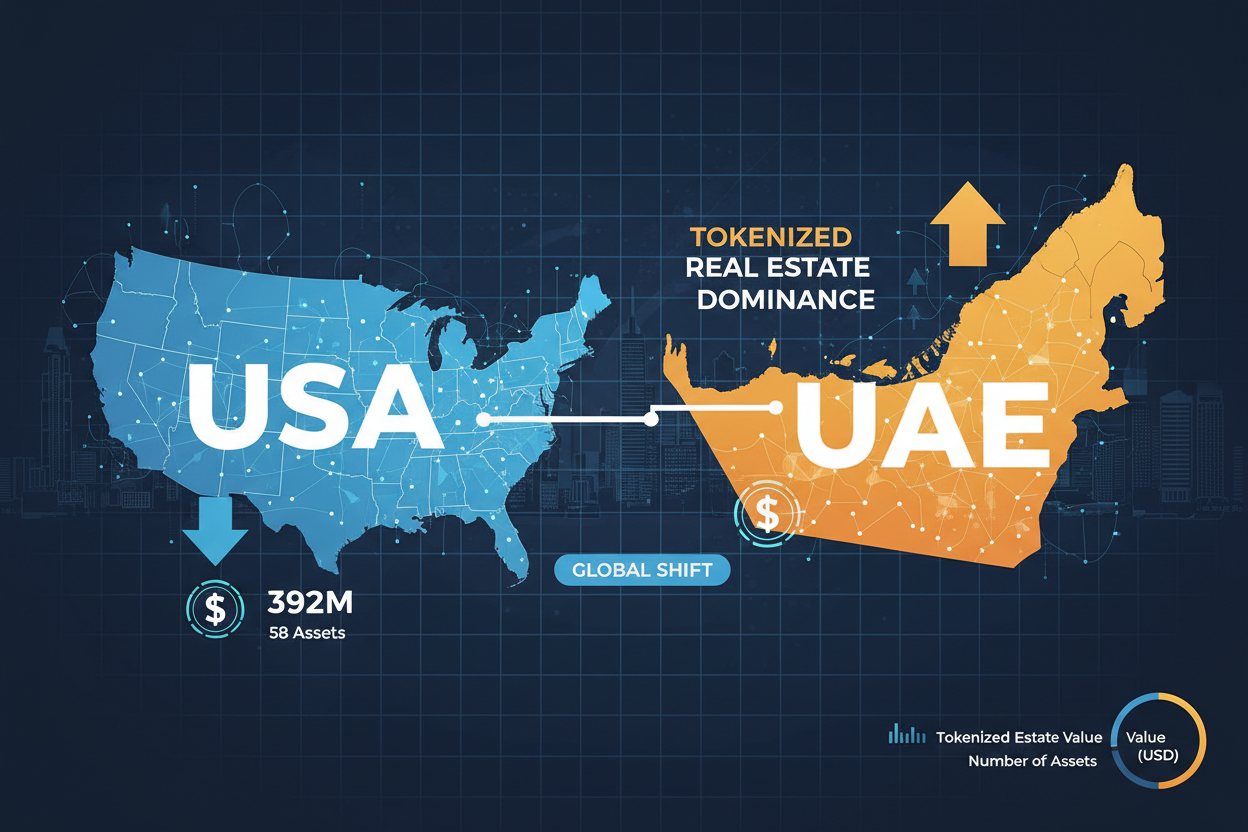
The UAE edges out in asset count with 23 properties valued at $129 million, fueled by Dubai's Land Department pilot program targeting $16 billion in tokenization by 2033, or 7% of the city's real estate. Meanwhile, the U. S. leads in value with 10 assets totaling $145 million, leveraging established platforms and diverse property types from urban condos to logistics warehouses. This on-chain real estate assets 2026 growth reflects broader real-world asset tokenization trends, though it pales against private credit at $18.91 billion or tokenized U. S. Treasuries over $9 billion.
U. S. Assets Anchor $145 Million in Tokenized Value
American tokenized properties exemplify market maturity, with standout offerings like SolidBlock's 60 Madison Avenue in New York, NY, a prime office tower token that captures Manhattan's enduring appeal. Nearby, the Manhattan Skyline Condo Token offers fractional ownership in a luxury high-rise, drawing investors seeking stable rental yields. RedSwan Crest Nashville Mansion in Tennessee stands out for its celebrity-adjacent allure, while RealT's Detroit Duplex #1 and E Jefferson Ave Apt highlight revitalization plays in the Midwest, where affordability meets blockchain efficiency.
Lofty's Palm Beach Condo in Florida taps into sunbelt demand, complemented by Propy's Miami Beachfront and South Beach Penthouse, which promise premium coastal returns. Harber Logistics Warehouse in Houston, TX, represents industrial diversification, as does tZERO's Chicago Office Tower. Further afield, Lofty Austin Townhome and RealT Atlanta Single Family Home cater to booming Sunbelt and Southern markets. These 10 U. S. assets, including INX Los Angeles Villa and Beverly Hills Estate Fractional, not only drive the $145 million valuation but also demonstrate USA tokenized properties $392M leadership through liquid secondary trading on compliant chains.
UAE's Proliferation: 23 Assets Fueling $129 Million Surge
Dubai's visionary policies propel the UAE's tokenized real estate boom, with Prypco's Dubai Marina Suite exemplifying waterfront luxury accessible via tokens. Emaar's Burj Khalifa Fractional ownership lets global investors claim slices of the world's tallest building, while Palm Jumeirah Beach Villa offers exclusive villa shares. Stake's Abu Dhabi Tower Apt and Yas Island Resort Share extend appeal to the capital's growth corridors.
Other notables include Dubai Hills Estate Token, Jumeirah Village Circle Duplex, Business Bay Office Space, Downtown Dubai Skyscraper, and DIFC Luxury Condo, blending residential, commercial, and hospitality assets. This lineup of 23 properties underscores fractional property tokens UAE innovation, supported by phase two of Dubai's tokenization pilot and platforms like Blocksquare. The concentration reflects regulatory clarity, contrasting with global peers.
Expanding the portfolio, additional U. S. tokens such as RealT Tampa Bayfront in Florida, Lofty Raleigh Tech Loft in North Carolina, and San Diego Coastal Home capture emerging hotspots with strong rental demand. Portland Brewery District, Columbus Ohio Family Home, and Indianapolis Warehouse Conversion reflect mid-tier markets offering value plays, while Kansas City BBQ District Loft, Milwaukee Lakefront Condo, RealT Baltimore Rowhouse, Pittsburgh Steel City Townhome, and Cleveland Lakeside Apt round out the domestic selection, emphasizing affordable entry points for diversified exposure.
Global Footprint: The Remaining 25 Assets Across Eight Countries
While USA and UAE properties dominate, the other 25 assets span eight nations, underscoring early real estate tokenization adoption beyond these hubs. In Europe, London Shard Fractional provides a stake in one of the city's iconic skyscrapers, Madrid Gran Via Apartment taps Spanish urban revival, Paris Eiffel Tower View offers landmark prestige, Berlin Mitte Loft appeals to tech-savvy creatives, and Amsterdam Canal House delivers historic charm. Asia contributes Tokyo Shibuya Property Token amid Japan's property rebound, Singapore Marina Bay Suite in a global finance nexus, and Sydney Harbour Bridge Share leveraging Australian stability. Rounding out the list, Toronto CN Tower Condo in Canada adds North American variety.
These international tokens, though comprising just 20% of the $392.5 million market, signal broadening appeal. Platforms like RealT and Lofty extend their models globally, yet face steeper regulatory hurdles compared to the USA-UAE clarity. Holdings here often prioritize long-term appreciation over immediate yields, with holders numbering 10,440 across all assets.
Tokenized Real Estate Market Value Predictions 2027-2032
Projections from $392.5M baseline in early 2026, driven by USA/UAE dominance (80% of assets) and Dubai's $16B tokenization target by 2033
| Year | Minimum Value | Average Value | Maximum Value | YoY Growth (Avg) |
|---|---|---|---|---|
| 2027 | $650M | $1.2B | $2.0B | +205% |
| 2028 | $1.1B | $2.5B | $4.5B | +108% |
| 2029 | $1.8B | $4.2B | $8.0B | +68% |
| 2030 | $2.8B | $6.5B | $12.0B | +55% |
| 2031 | $4.0B | $9.5B | $17.0B | +46% |
| 2032 | $5.5B | $13.0B | $23.0B | +37% |
Price Prediction Summary
The tokenized real estate sector is forecasted for substantial expansion, with average market value reaching $6.5B by 2030 and $13B by 2032 amid high adoption in USA and UAE. Bullish maxima align with Dubai's ambitious targets and RWA trends, while minima reflect regulatory and liquidity risks.
Key Factors Affecting Tokenized Real Estate Price
- Dubai Land Department's tokenization pilot targeting $16B (7% of market) by 2033
- USA ($145M current) and UAE ($129M current) leading with 80% market share
- Institutional adoption and RWA market growth beyond real estate ($28B+ total)
- Blockchain scalability and secondary market development to boost liquidity
- Crypto bull cycles vs. regulatory hurdles and low trading volumes
- Competition from tokenized treasuries ($9B+) and private credit ($19B)
Disclaimer: Cryptocurrency price predictions are speculative and based on current market analysis. Actual prices may vary significantly due to market volatility, regulatory changes, and other factors. Always do your own research before making investment decisions.
Regulatory tailwinds propel this trajectory. Dubai's Land Department pilot, now in phase two, aims for $16 billion tokenized by 2033, equating to 7% of its real estate stock. U. S. platforms benefit from SEC-compliant structures via Reg D and Reg A and, enabling broader investor access. Yet challenges loom: secondary market volumes remain subdued, average holding periods stretch beyond six months, and cross-border legalities deter flips. Compared to tokenized Treasuries surpassing $9 billion or private credit at $18.91 billion, real estate tokens represent nascent liquidity.
Investor Considerations: Yield, Risk, and Research Imperative
For forward-thinking portfolios, these 58 assets offer yields averaging 8-12% from rentals, outpacing traditional REITs amid inflation. USA tokens like SolidBlock 60 Madison Avenue provide office resilience, while UAE's Emaar Burj Khalifa Fractional marries scarcity with tourism rebound. Risks include platform dependency, oracle price feeds for valuations, and jurisdiction-specific taxes. Low on-chain activity, as tracked by Yellow. com and Bitget, demands patience, but 396 active markets hint at maturation.
Methodical analysis reveals cycles: U. S. Sunbelt surges mirror 2021-2023 migration, UAE growth tracks Expo 2020 legacies and golden visas. Platforms such as Propy, tZERO, INX, and Stake integrate KYC for compliance, mitigating wash trading. Global outliers like Phoenix Desert Residence or DIFC Luxury Condo exemplify niche bets, yet USA-UAE concentration mitigates volatility through scale.
Stakeholders should prioritize on-chain transparency, auditing token supplies against property deeds, and yield histories. Dubai's initiatives, per Instagram updates from dubainews24x7, and U. S. pilots signal acceleration. As tokenized real estate evolves, the USA-UAE duo sets benchmarks, inviting research-driven entries into this $392.5 million frontier before broader adoption dilutes alpha opportunities.

No comments yet. Be the first to share your thoughts!