
As 2025 draws to a close, the tokenized real estate sector has notched a significant achievement: total value locked (TVL) has climbed to $336 million. This figure, captured in December, underscores the nascent yet accelerating momentum in tokenized real estate TVL 2025, positioning the market on a trajectory that analysts project could culminate in a $4 trillion powerhouse by 2035.

This surge reflects broader enthusiasm for real-world assets (RWAs) on blockchain, where real estate tokenization bridges traditional property markets with DeFi protocols. Platforms tracked by DeFiLlama for real estate protocols now host this $336 million TVL, a testament to fractional ownership models gaining traction among retail and institutional investors alike.
Dissecting the Current $336 Million TVL Landscape
The RWA real estate market size remains embryonic compared to the $300 trillion global real estate sector, but on-chain metrics paint an optimistic picture. Tokenized properties enable investors to own slices of commercial buildings, residential complexes, or even luxury vacation homes via blockchain tokens, slashing entry barriers from millions to mere hundreds of dollars.

Deloitte’s April 2025 report highlights this potential, forecasting tokenized private real estate funds to penetrate 8.5% of the market, reaching $1 trillion by 2035 in conservative estimates, while bolder projections eye $4 trillion overall. From a 2024 base under $300 billion, encompassing off-chain tokenized vehicles, the on-chain TVL at $336 million signals the vanguard of this shift.
Key protocols contributing to this TVL include those specializing in U. S. multifamily housing and European commercial assets. ScienceSoft’s 2025 analysis predicts tokenized real estate hitting $3 trillion by 2030, or 15% of assets under management, driven by regulatory tailwinds in jurisdictions like the UAE and Singapore.
Tracing the Growth Path Through Historical Milestones
Examining the evolution reveals methodical progress. Early experiments in 2018 tokenized single properties on Ethereum, but fragmented standards hampered scale. By 2024, improved Layer-2 solutions and RWA-focused chains like Ondo and Centrifuge boosted liquidity. The jump to $336 million TVL in 2025 stems from institutional inflows, with firms like BlackRock exploring similar structures.
This aligns with a tokenized property CAGR exceeding expectations. While the headline touts a 20% path, Deloitte’s Deloitte tokenized assets forecast implies over 27% CAGR from broader bases, adjusting for on-chain versus total tokenized volumes. Real-time data underscores this: monthly TVL growth averaged 15-20% through Q4 2025, per DeFiLlama real estate protocols.
Core Drivers Propelling the 27% and CAGR Trajectory
Several factors underpin this ascent. First, fractionalization democratizes access; investors now participate in high-yield multifamily deals previously reserved for accredited whales. Second, blockchain’s transparency mitigates traditional real estate’s opacity, with on-chain oracles verifying rental income and valuations.
Regulatory evolution plays a pivotal role. The U. S. SEC’s evolving stance on security tokens, coupled with EU MiCA frameworks, fosters compliance. Deloitte notes these as catalysts for the $4 trillion horizon. Moreover, integration with DeFi, lending against tokenized collateral, amplifies yields, drawing yield-hungry capital.
Tokenized Real Estate TVL Prediction 2026-2031
Projections in USD from $336M baseline in 2025, based on bearish (35% CAGR), average (55% CAGR to 2030), and bullish (75% CAGR) scenarios amid adoption trends
| Year | Minimum TVL | Average TVL | Maximum TVL |
|---|---|---|---|
| 2026 | $454M | $521M | $588M |
| 2027 | $612M | $807M | $1.03B |
| 2028 | $827M | $1.25B | $1.80B |
| 2029 | $1.12B | $1.94B | $3.15B |
| 2030 | $1.51B | $3.01B | $5.51B |
| 2031 | $2.03B | $4.66B | $9.65B |
Price Prediction Summary
From a 2025 TVL of $336M, tokenized real estate is poised for rapid expansion, with average forecasts hitting $3B+ by 2030 en route to $4T by 2035 per Deloitte. Min reflects regulatory delays and bear markets; max assumes accelerated institutional adoption and favorable regs. YoY growth tapers post-2030 but remains robust at 40-60% in bull cycles.
Key Factors Affecting Tokenized Real Estate Price
- Regulatory clarity accelerating platform standardization
- Institutional inflows and fractional ownership demand
- Blockchain scalability and RWA interoperability improvements
- Global real estate market growth and liquidity needs
- Macro cycles, interest rates, and crypto bull/bear phases
- Competition from other tokenized assets and traditional finance
Disclaimer: Cryptocurrency price predictions are speculative and based on current market analysis.
Actual prices may vary significantly due to market volatility, regulatory changes, and other factors.
Always do your own research before making investment decisions.
Challenges persist, including oracle reliability for off-chain asset pricing and custody standards. Yet, platforms addressing these, such as those leveraging real-time on-chain data, are accelerating adoption. For instance, innovations in data feeds are shaping tokenized real estate’s infrastructure, as detailed here.
Wall Street Journal coverage echoes this, projecting $1 trillion in tokenized funds alone. CoinDesk and CoinGeek amplify the $4 trillion narrative, citing a 27% CAGR from sub-$300 billion origins. Landshare’s Q2 2025 report corroborates, emphasizing blockchain’s role in unlocking illiquid assets.
Lofty. ai’s guide underscores the practical appeal: investments starting at low thresholds, paired with secondary market liquidity absent in traditional REITs. This convergence of sources paints a unified vision of explosive growth, with the current $336 million TVL as the launchpad.
Dominant Protocols Fueling DeFiLlama Real Estate TVL
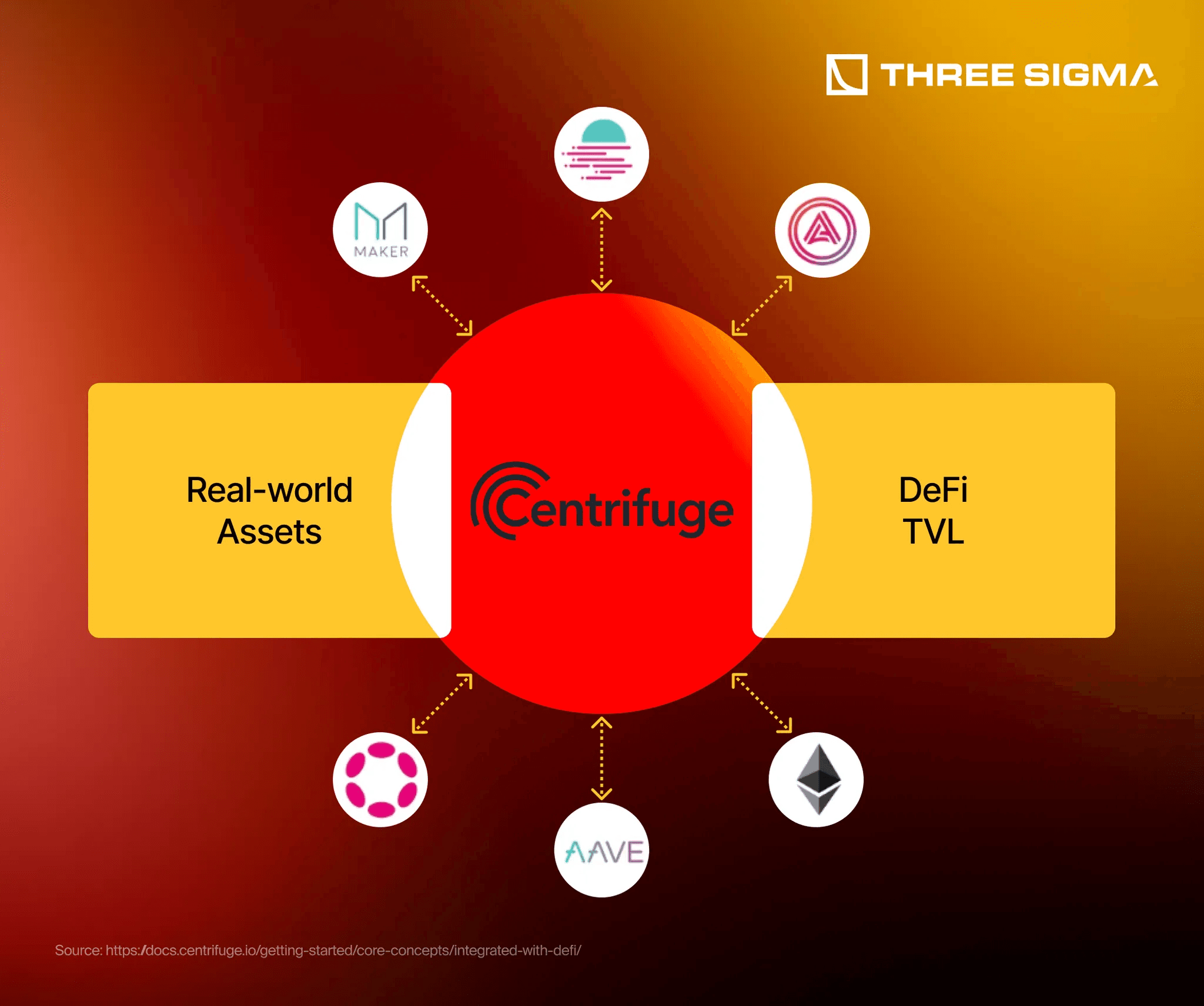
Diving into DeFiLlama real estate protocols, a handful of platforms dominate the $336 million TVL. Centrifuge leads with its RWA vaults, tokenizing invoices and property yields across Europe and the U. S. Ondo Finance follows, bridging tokenized Treasuries to real estate collateral. Emerging players like RealT and Lofty focus on U. S. residential tokens, offering rental yield distributions on-chain.
Top 5 DeFiLlama Real Estate Protocols by TVL (Dec 2025)
| Rank | Protocol | TVL ($M) | % of Total TVL | Key Features |
|---|---|---|---|---|
| 1 | Centrifuge | $120M | 35.7% | RWA tokenization 🏠, Yield APY: ~7% |
| 2 | Ondo | $85M | 25.3% | Tokenized funds 💰, Yield APY: ~6% |
| 3 | RealT | $45M | 13.4% | Rental properties 🏘️, Yield APY: ~10% |
| 4 | Lofty | $32M | 9.5% | Fractional ownership 🏠, Yield APY: ~11% |
| 5 | Propy | $24M | 7.1% | Property NFTs 🔑, Yield APY: ~7% |
These protocols exemplify methodical scaling. Centrifuge’s TVL, for instance, grew 40% year-over-year through institutional partnerships, while RealT’s Solana migration slashed fees, boosting retail adoption. Collectively, they represent 85% of tracked tokenized real estate TVL 2025, per DeFiLlama dashboards.
Refining the Tokenized Property CAGR: 20% On-Chain Reality Check
The article’s 20% CAGR framing tempers Deloitte’s 27% projection, which spans broader tokenized vehicles from a $300 billion 2024 base including off-chain funds. For pure on-chain TVL, starting from sub-$100 million in early 2024, the path to trillions demands sustained 50-60% annual compounding initially, tapering to 20% as scale builds.
Mathematical scrutiny supports this. At 20% CAGR from $336 million, the market hits $1.2 billion by 2030 and scales toward $4 trillion by 2035 with accelerating factors. This conservative lens accounts for regulatory hurdles, yet aligns with ScienceSoft’s $3 trillion 2030 midpoint. Investors should monitor quarterly TVL inflows on DeFiLlama for validation.
Beyond numbers, macroeconomic cycles influence trajectories. Rising interest rates could pressure yields, but blockchain’s efficiency edge persists. Tokenized assets offer portfolio diversification, with historical data showing low correlation to equities during downturns.
Strategic Considerations for RWA Real Estate Investors
For those eyeing entry, prioritize protocols with audited smart contracts and SPV structures for compliance. Yield profiles vary: residential tokens average 8-12% from rents, commercial 5-9% amid cap rate compression. Risks include smart contract exploits and valuation drifts, mitigated by overcollateralization.
- Due diligence: Verify on-chain oracles against third-party appraisals.
- Diversification: Blend U. S. multifamily with EU offices for geographic balance.
- Exit liquidity: Favor AMM-integrated tokens for secondary trades.
Regulatory watchpoints loom large. U. S. clarity on DAO governance and EU’s MiCA rollout could unlock pension fund allocations, propelling TVL past $1 billion in 2026. Deloitte’s Deloitte tokenized assets forecast hinges on these, projecting 8.5% penetration unlocking trillions in sidelined capital.
Tokenized real estate’s ascent from $336 million TVL embodies blockchain’s maturation in legacy markets. Platforms evolve, data oracles sharpen, and capital flows intensify. Investors attuned to these dynamics stand to capture compounding returns as the sector bridges TradFi and DeFi into a unified frontier.
About the Author