
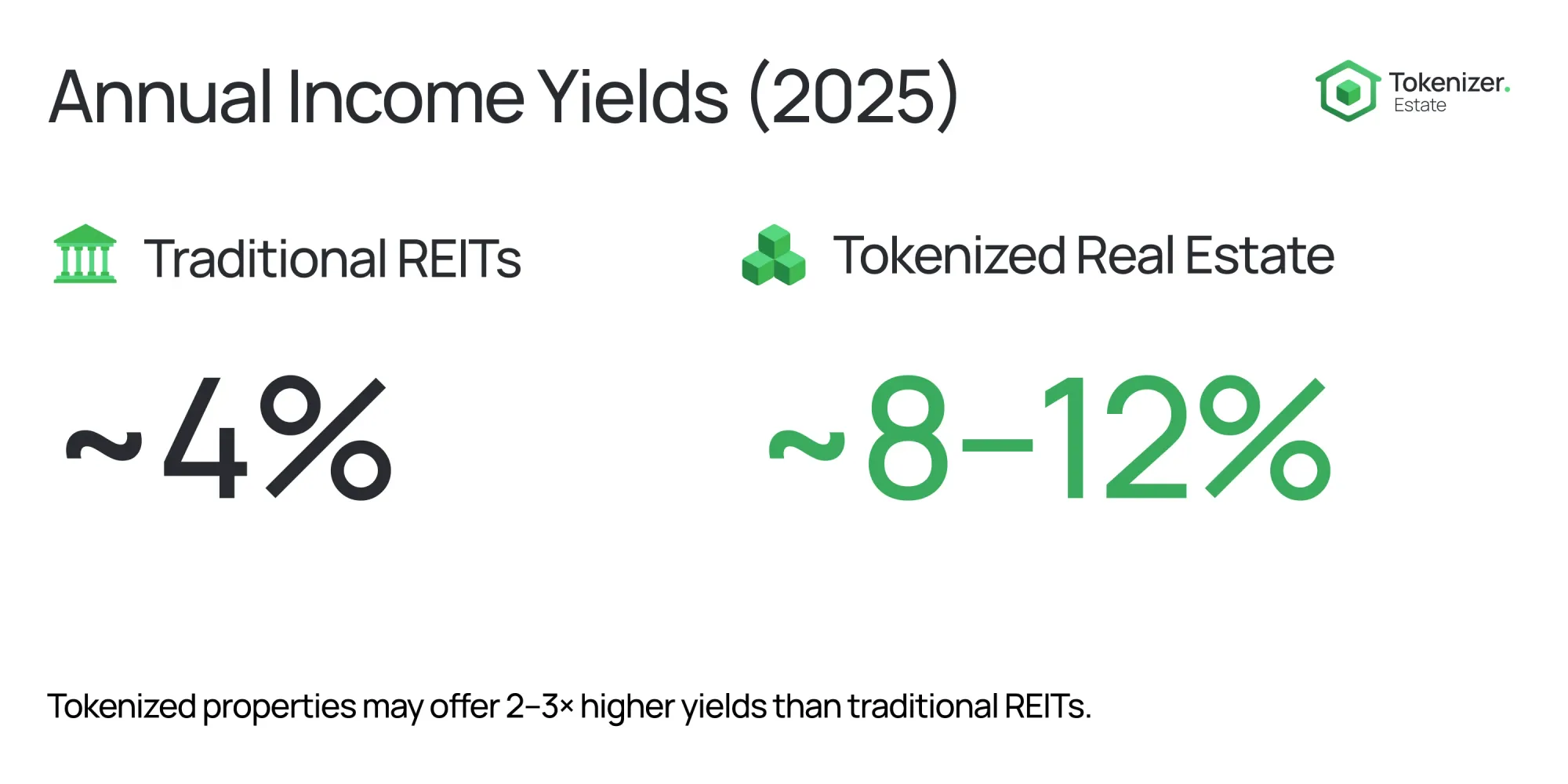
Yield comparison at a glance
Tokenized real estate and public REITs generate returns through fundamentally different mechanisms. Public REITs rely on broad market exposure and dividend distributions, while tokenized assets offer direct exposure to specific property cash flows and appreciation. In the 2026 market, this structural difference creates distinct yield profiles for investors.
Public REITs typically offer lower but more stable yields, generally ranging from 3% to 6%. These returns are driven by dividend payouts and are subject to broader real estate market cycles and interest rate fluctuations. In contrast, tokenized real estate yields vary significantly by platform and asset quality. While some platforms report yields between 8% and 12%, these figures are highly variable and platform-dependent, reflecting the higher risk and illiquidity premiums inherent in fractional ownership structures.
The following table contrasts the key yield and structural differences between these two investment vehicles. This comparison highlights the trade-offs between liquidity, minimum investment, and potential return.
| Metric | Tokenized Real Estate | Public REITs | Risk Note |
|---|---|---|---|
| Typical Yield Range | 8%–12% (variable) | 3%–6% | Tokenized yields depend on platform and asset performance. |
| Liquidity | Low (secondary markets) | High (daily trading) | REITs can be sold instantly; tokenized assets may take days. |
| Minimum Investment | $100–$1,000 | $10–$100 (share price) | Both offer low entry points, but REITs have no lock-up. |
| Fee Structure | Platform fees (1–2%) | Expense ratios (0.2–0.5%) | Tokenized platforms often charge higher operational fees. |
Why tokenized yields often run higher
Tokenized real estate yields frequently outpace traditional REITs because they strip away the structural layers that typically erode investor returns. The difference is not magic; it is a matter of operational efficiency and direct asset exposure.
Traditional REITs are corporate entities with significant overhead. They pay property managers, asset managers, and corporate staff. They also face double taxation in some structures, where the REIT pays corporate tax on profits before distributing dividends to shareholders. These costs are baked into the expense ratio, which typically ranges from 1% to 2% annually. In contrast, tokenized platforms use smart contracts to automate distributions and ownership records. This automation reduces administrative friction, allowing a larger share of the property’s net operating income to flow directly to token holders.
There is also the factor of the illiquidity premium. While tokenized real estate is more liquid than buying a whole building, it is still less liquid than publicly traded REIT shares. Platforms compensate investors for this relative lock-up with higher yield expectations. Because tokenization allows for fractional ownership, platforms can access high-yield commercial properties that were previously out of reach for individual investors, capturing value from a broader pool of assets.
However, higher yields come with caveats. These platforms are still emerging, and regulatory frameworks are evolving. The yields are variable and platform-dependent. Always verify the fee structure and legal structure of any tokenized offering before investing.
Liquidity and Trading Mechanics
The liquidity profile of tokenized real estate differs fundamentally from traditional REITs, creating a distinct trade-off between convenience and market access. REITs trade on public exchanges like stocks, offering investors the ability to exit positions instantly during market hours. Tokenized real estate, by contrast, lacks this immediate public market exit. Liquidity depends on secondary trading platforms or specific buyback programs offered by the issuing platform, which can introduce delays and variable pricing.
This structural difference becomes critical during market downturns. When real estate values decline, REIT investors can sell instantly, though potentially at a loss. Tokenized asset holders may find themselves unable to sell if secondary market volume is thin or if the platform’s buyback mechanism is paused. This illiquidity premium is often baked into the higher yield expectations of tokenized assets, but it does not guarantee an easy exit when capital is needed most.
The total value of tokenized real-world assets grew to over $24 billion by early 2026, reflecting rapid adoption among high-net-worth individuals and institutions 1. However, this growth in total value does not equate to liquid depth. Most tokenized properties trade on niche platforms with limited participant pools, meaning bid-ask spreads can widen significantly compared to the tight spreads of major REIT exchanges.
Investors must weigh this liquidity constraint against the potential for higher yields. While tokenized real estate may offer superior annualized returns, the inability to quickly convert those holdings to cash is a tangible risk. For investors requiring flexible access to capital, the instant liquidity of REITs remains a compelling advantage, even if it comes with lower yield potential.
Regulatory Risks and Compliance
The rapid expansion of tokenized real estate in 2026 is outpacing the establishment of clear regulatory frameworks, creating a high-stakes environment for yield security. While institutional investors are increasingly allocating capital—expecting to hold 5.6% of portfolios in tokenized assets by 2026—the legal structures underpinning these yields remain fragmented. High Stakes
The Securities and Exchange Commission (SEC) has intensified its scrutiny of digital asset platforms, treating many tokenized real estate offerings as unregistered securities. This regulatory pressure means that platforms operating without robust compliance protocols face significant legal risks, including potential shutdowns or asset freezes. For investors, this translates directly into yield volatility and the risk of capital impairment if a platform fails to meet evolving federal standards.
Compliance is not merely a legal formality; it is the primary determinant of yield stability. Reputable platforms adhere to strict Know Your Customer (KYC) and Anti-Money Laundering (AML) protocols, often integrating blockchain analytics to monitor transaction flows. In contrast, non-compliant platforms may offer higher initial yields to attract liquidity, but these returns are often unsustainable and carry the hidden cost of regulatory intervention. The 21.0% CAGR projected for the real estate tokenization market through 2035, as noted by ScienceSoft, highlights the sector's growth, but also underscores the urgency of regulatory clarity. Investors must prioritize platforms that demonstrate transparent compliance records over those promising exceptional, unverified returns.
The divergence between traditional REITs and fractional tokenized ownership is stark in this regard. Traditional REITs operate under established Securities Act of 1933 guidelines, providing a layer of investor protection that newer tokenized platforms are still striving to match. As the market for tokenized real estate assets approaches $3 trillion by 2030, the platforms that survive will likely be those that integrate regulatory compliance into their core architecture, ensuring that yields are generated from legitimate, legally protected property rights rather than speculative token dynamics.
Which strategy fits your portfolio
Choosing between tokenized real estate and traditional REITs requires aligning your investment goals with the structural differences of each asset class. Tokenized real estate offers higher potential yields and fractional liquidity but carries platform-specific and regulatory risks. Traditional REITs provide stability, transparency, and established dividend histories backed by regulated markets.
Tokenized real estate platforms often advertise yields between 8% and 12%, driven by direct property income and potential appreciation. However, these returns are variable and depend on the underlying asset’s performance and the platform’s operational integrity. The market is still maturing, with total tokenized real-world assets reaching over $24 billion by early 2026, up 266% in 2025. This growth signals increasing adoption but also highlights the sector’s volatility compared to established financial instruments.
| Feature | Tokenized Real Estate | Traditional REITs |
|---|---|---|
| Yield Range | 8-12% (variable) | 4-6% (dividend-focused) |
| Liquidity | Secondary markets (platform-dependent) | Daily (exchange-traded) |
| Minimum Investment | $10-$100 | $10-$100 (share price) |
| Regulation | Evolving (SEC/ESMA oversight) | Established (SEC/NAREIT) |
| Transparency | Blockchain-based (real-time) | Quarterly filings (10-Q/10-K) |
For investors seeking higher yields and willing to accept platform risk, tokenized real estate offers a compelling entry point with low minimums. Those prioritizing stability, regulatory protection, and daily liquidity should stick with traditional REITs. The choice ultimately depends on your risk tolerance and liquidity needs.
No comments yet. Be the first to share your thoughts!